Showing posts with label Optimization. Show all posts

Tuesday, July 26, 2016

Boost your mobile performance with the right ad sizes

Were paying special attention to improving the mobile ad experience to help empower content creators, news organizations, and publishers. As mobile continues to grow, choosing high-impact mobile ads are key for businesses to generate revenue from a mobile audience.

When choosing the right mobile ad units for your business, its a best practice to ensure that each and every mobile impression receives the highest value possible, which can be determined by a mix of metrics like viewability, size, placement, and demand.

Its also important to protect the user experience by choosing the right ad formats and placements for your site to engage mobile users so that you dont interrupt their desired intent.

Start by choosing a high-impact mobile format: medium rectangle (300x250), large rectangle (336x280), large mobile banner (320x100), and rectangular responsive ad units tend to get the best results. Heres why we recommend these formats:


  • Each format works well on both desktop and mobile (with the exception of the large mobile banner). This gives advertisers the opportunity to appear on a variety of screens which increases demand, upward auction pressure, and potentially even earnings. The large mobile banner will also allow 320x50 display ads to appear within this format, which increases competition. If the 320x50 ad unit wins the auction, it will always be vertically aligned to the top.
  • These formats are bigger and more engaging than smaller mobile units, so they'll grab user's attention. Here's an example of what the medium rectangle looks like placed above the fold, yet below the main content.

For additional changes for incremental revenue gains, you may want to consider trying link units. Link units are designed to be responsive, so they work with both mobile and desktop. You can add up to three link units in addition to the default limit of 3 ad units per page.

However critical mobile is to your business today, it will be more critical tomorrow. Energize your mobile strategy today by using high-impact mobile ads, theyre a great way for businesses to generate more revenue and engage your users. 


Wednesday, May 25, 2016

More personalized recommendations with automatic experiments

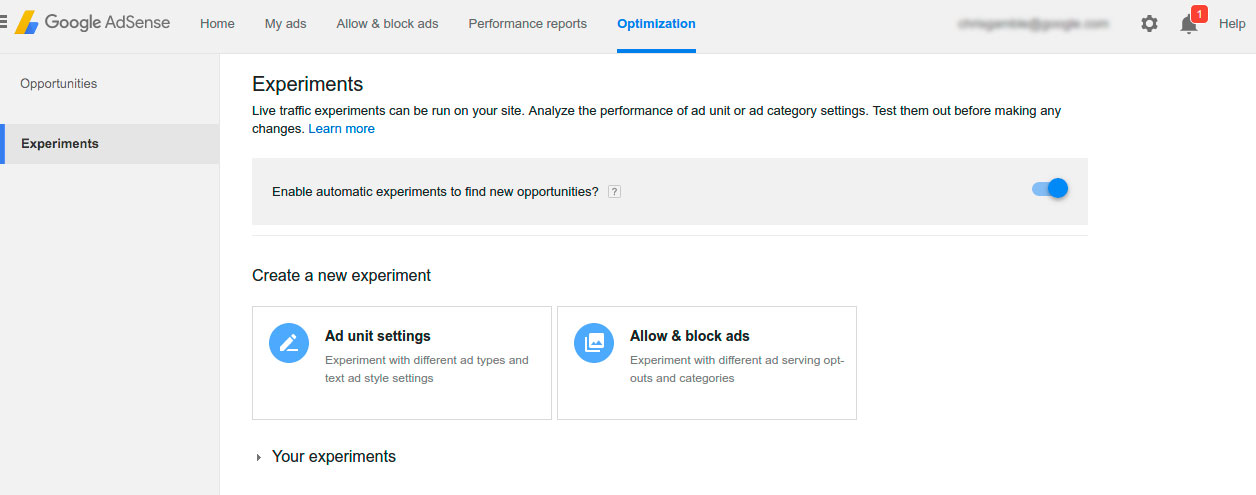
Today we�ve launched automatic experiments*, the latest addition to our suite of optimization tools.

Enabling this feature allows us to run automatic experiments on a small portion of your traffic and provide you with insightful data about which ads perform best on your site. This could help you optimize your ads and potentially increase your long-term revenue and user engagement on your site**.

To enable automatic experiments on your site, visit the "Experiments" page on your Optimization tab, and switch on "automatic experiments".


The opportunities generated from these experiments will appear in the �Opportunities� page on your Optimization tab. They'll be labelled "verified by experiment,� so you�ll know they�re backed by data and tailored to your site and users.

To learn more, visit the Help Center.

We'd love to hear your feedback in the comments below!


Posted by Chris Gamble, Software Engineer


*Automatic experiments will appear in your account if you have enough eligible traffic.
**These suggestions are designed to help you optimize your pages and are not meant to guarantee any specific results. And, just as a reminder, you are responsible for the content and layout of your site. 

Monday, April 18, 2016

[New Resource] Download the AdSense Guide to Audience Engagement


Research shows that �29% of smartphone users will immediately switch to another site or app if it doesn�t satisfy their needs.

In a world where people are making split decisions about what to consume, it�s increasingly challenging but critical for publishers to figure out how to effectively engage their audiences on their sites. To help lay the foundation to a winning engagement strategy, we�ve created the AdSense Guide to Audience Engagement.

This guide help you drive toward your goals for growing your site � from defining your brand voice to tips to make your site�s content easy to consume. Don�t waste another moment developing web pages that leave you with little opportunity to engage with your audience. Download the AdSense Guide to Audience Engagement here.

In this guide, you�ll learn:

  • How to help your audience become familiar with your brand
  • Best practices to design delightful user journeys
  • How to develop content that resonates with your audience
  • Ways to make your content easy to consume
  • Why you should share the love with other sites by referring to good sources


Check out the guide and share your feedback with us on Google+ and Twitter using #AdSenseGuide. We�d love to hear what you think. 


Posted by Jay Castro
from the AdSense team

Tuesday, March 8, 2016

Viewability Spotlight for Sellers: 4 ways to improve ad layouts for better viewability

Our latest infographic puts a spotlight on viewability by sharing a dozen technical best practices for improving viewability based on insights from Active View, Google's MRC-accredited viewable impression measurement technology.

On this blog, we're breaking down the best practices into small, approachable chunks. Already, we've focused on 2 tips for enabling viewability measurement, and 3 speedy ways to improve viewability. In this post you'll learn tips for laying out ads on a webpage or scrollable page in an app in order to improve viewability rates.

Here is today's recommendation:


We hope these recommendations are improving your site or apps ad viewability. Feel free to share your viewability success story in the comments section below.

In the next part of our Spotlight on Viewability, we'll share 3 content and ad loading methods that can improve viewability.

Posted by Anish Kattukaran 

Friday, March 4, 2016

Why are my earnings down right now?

Four things to explore if your AdSense earnings take a dip

Today we'd like to share some insights about why AdSense earnings sometimes go down -- and look at how to troubleshoot what's going on when that happens. Google has a variety of tools and reports that will help you see what might be causing a decline and how you can respond to optimize your earnings.


One of the first things to consider is: have your overall page views gone down, or are other issues causing the drop? There are many factors that affect revenue, but the key ones to look at include:
  • Clickthrough rate (CTR)
  • Cost per click (CPC)
  • Page revenue per thousand impressions (page RPM)
  • Page views
You can view all these metrics on the Performance reports tab in your AdSense account. Here are a few tips on how to address issues you may discover.

1. My page views have decreased

When troubleshooting changes in page views, it's a good idea to extend the date range of your reports out to 30 days or more to help identify trends or specific issues. A drop in page views could simply be seasonal; retailers, for instance, tend to see a traffic drop after the holiday season. But a decrease can also be due to a change in your content.

If your traffic has dropped, here are some ways you might increase it:

  • Promote your site with other major sites that cover the same topics.
  • Promote your site through social media, and create a group of interested people who regularly visit your site.
  • Use Google Search Console to make sure your site is being correctly crawled and indexed.
  • Update your site regularly to encourage repeat visitors. You might also want to send out an email or a newsletter about your updates.

2. My cost per click has decreased

CPC is market-driven and depends on factors like advertiser bids on keywords and the CPC values they're willing to pay. For example, CPC can fall at the beginning of each quarter when marketers are shifting budget. When looking at changes in CPC, it's a good practice to extend the date range of your reports out to a year. Then:

  • See if you're using the best-performing ad sizes. Generally, our most successful sizes for CPC and CTR are 720x90, 336x280, 160x600, and the 320x100 mobile banner. Learn more about the most successful ad sizes.
  • Make sure you're not blocking ads you don't need to. Blocks on too many advertisers, ad networks, general or sensitive categories will often decrease CPC because there are fewer advertisers in the auction bidding on your inventory. The more inventory your site has access to, the greater the chance that auction pressure will drive up your CPC.
  • Look at how seasonality can affect your advertisers' bids. For instance, swimsuit advertisers often increase their bids in the early weeks of summer. But if your site caters only to students, you should expect traffic to fall in the summer. Learn more about how the ad auction works for a clearer understanding of how these kinds of changes can impact your earnings.

3. My search rank has dropped

Deeper investigation may show you that your page is not ranked as highly in search results as it once was. The Webmaster Troubleshooter is designed to help you resolve common issues with your site in Google Search and the Google Search Console.

4. My CTR or page RPM has decreased

A drop in CTR or page RPM can be caused by confusing site design or poor targeting. Visitors who see your ads might not click on them because they find them irrelevant, or perhaps they don't see your ads at all. And that leads to lower earnings.

Here are some best practices to help drive up your CTR and page RPM:


We hope these tips will help you understand exactly what's happening on your site ? and send your earnings back in the right direction.


Posted by Rachel Barrett
Google AdSense Team

Thursday, March 3, 2016

Viewability Spotlight for Sellers: 3 speedy ways to improve viewability

Our latest infographic puts a spotlight on viewability by sharing a dozen technical best practices for improving viewability based on insights from Active View, Google's MRC-accredited viewable impression measurement technology.

Recently on the blog, we focused on 2 tips for enabling viewability measurement. In this post you'll learn tips for improving ad viewability by optimizing your apps and sites for speed and responsiveness.

Here is today's recommendation:


We hope these recommendations are improving your site or apps ad viewability. Feel free to share your viewability success story in the comments section below.

In the next part of our Spotlight on Viewability, we'll share 4 ways to improve ad layouts for better viewability rates.

Posted by Anish Kattukaran,
Product Marketing Manager

Wednesday, March 2, 2016

Viewability Spotlight for Sellers: 2 tips to enable viewability measurement

There's a lot that publishers and app developers can do to increase the likelihood that their ads will be measured as viewable. Our latest infographic puts a spotlight on viewability by sharing a dozen technical best practices for improving viewability across four categories based on insights from Active View, Google's MRC-accredited viewable impression measurement technology. These insights and recommendations come from our services teams that have spent thousands of hours working with publishers and developers to improve advertising outcomes.

In this post, we focus on tips you can use to improve ad viewability by optimizing your apps and sites for speed and responsiveness.

Here is today's recommendation:


We hope these recommendations will improve your site or apps ad viewability. Feel free to share your viewability success story in the comments section below. 

In the next part of our Spotlight on Viewability, we'll share 3 speedy ways to improve viewability.

Posted by Anish Kattukaran,
Product Marketing Manager

Tuesday, March 1, 2016

Viewability Spotlight for Sellers: Best practices for improving ad viewability

Increasing the total number of viewable ad impressions has been shown to improve the performance of ads on sites and apps and increase advertiser satisfaction. To help publishers and app developers increase the likelihood that their ads will be measured as viewable, we're excited to share the viewability spotlight infographic. It contains a dozen technical best practices for improving viewability across four categories based on insights from Active View, Google's MRC-accredited viewable impression measurement technology.

The infographic covers how to:
  • Enable viewability measurement
  • Optimize for speed and responsiveness
  • Lay out ads for optimal viewability
  • Load ads and content for optimal viewability
Publishers and app developers across the globe have been able to seamlessly measure viewability, at no additional charge, with the launch of Google�s Active View technology in DoubleClick for Publishers, DoubleClick Ad Exchange, AdSense and AdMob. The tips in the viewability spotlight infographic can help you go beyond simply understanding viewability rates to optimizing viewability on your site or app so that all of your impressions are viewable.

These insights and recommendations come from our services teams that have spent thousands of hours working with publishers and developers to improve advertising outcomes.

Download your copy of the viewability spotlight infographic now.

Posted by Anish Kattukaran, Product Marketing Manager


Wednesday, January 13, 2016

Explore opportunities with the new AdSense Optimization tab

Today, we�re excited to announce the new Optimization tab, a dedicated place in your AdSense account that shows tailored tips for your site. This new tab is a one-stop shop for all the resources that could help you increase your revenue and user engagement on your site.

With the new Optimization tab, you can:
  • Explore new opportunities and features that could boost your income
  • Run A/B experiments and check results to make better decisions for your site
  • Find valuable optimization resources in one place
The new Optimization tab is currently in beta and available for a limited group of publishers. It will roll out to all AdSense publishers over the coming weeks. Check your account now to see if you have this exciting feature in your account!
To create a great optimization experience for you, we�re planning to add more features to the new Optimization tab, including new experiment features and a host of new opportunities. We hope that this new tab will help you explore more opportunities for your site and continue to turn your passion into profit.

We�d love to hear your feedback. Let us know what you think in the comments section below.


Posted by Ben Birt
Software Engineer

Tuesday, December 8, 2015

Getting to know Active View and the world of viewability

We've had a lot of questions recently from AdSense publishers about viewability and the new Active View metrics in AdSense accounts. Active View can really help you improve your AdSense earnings, so let's take a closer look.

What are Active View and viewability?

Active View is Google�s ad viewability measurement solution. It tracks the viewability of ads served by AdSense: that is, the percentage of ads that are considered viewable out of the total number of ads measured. We use the online ad industry standard: a display ad is counted as viewable when at least 50% of the ad is within the viewable space on the user�s screen for one second or more.
So an ad that is (for instance) placed below the first screen on a given page won't be counted as viewable if the viewer never scrolls down. This is why viewability a good way of determining whether your AdSense ads are actually being seen by your website visitors or simply loading without a chance of catching the viewer's eye.

Why is viewability important?

The industry shift towards viewability is good for both publishers and advertisers for many reasons.
  • Benefits for advertisers and the advertising industry
Without viewability metrics, advertisers could be paying for ads that loaded on a page but were never seen. If you're an advertiser paying per click you might not care, but if you're paying by the impression it could be a much bigger deal.

Active View metrics help because they show advertisers what percentage of their ads are actually being seen by users and which publishers provide the highest level of viewability. This helps advertisers make smarter decisions about where they should buy ad impressions. That makes display ads both more measurable and more effective.
  • Benefits for publishers
Viewability metrics also help publishers understand the true performance of the AdSense ads they display. Whether the ad is being paid for by click or by impression, ads that aren't seen by the user can�t have an impact. In the long run, they won�t generate reliable ad revenue.

If publishers notice that the Active View percentage for certain ad units is lower than others, that ad position is probably underperforming and ought to be optimized. Active View can help publishers increase their AdSense earnings as they take corrective action and improve the performance of these ads.

How to improve your ad viewability

Once you become familiar with viewability statistics, there are two changes you can make to improve your results.
  • Change ad sizes
Vertical ad units such as 160x600 and 120x600 tend to have higher Active View percentages. This makes sense: vertical ad units are in view for longer as the user scrolls up or down the page. Other ad sizes with high viewability rates include the 120x240 and 240x400 ad units.
  • Change ad positions
Rethinking the position of your AdSense ad units can also help improve your viewability rates. It's not always just a matter of putting more ads at the top of the page: for example, ads positioned just above the fold tend to have higher viewability rates since they remain within view for longer as the user scrolls down. Experiment with what works best on your site.

Paying close attention to your Active View numbers will help you bring your visitors the targeted ads you want them to see and remove the uncertainty around unviewable ads. In the end, that should mean fewer underperforming ad units and a potentially a new way to achieve better revenues overall.
We think that in the long term viewability will change the way that advertisers allocate their budgets to online display. And if you're a publisher, it's a good idea to start paying attention to these new numbers and make adjustments to your ad sizes, ad units, and ad positions to improve viewability and potentially achieve better results.

To learn more about viewability and Active View, see the AdSense Help Center.

Not yet an AdSense user? Sign up now!


Posted by Paul Healy
Publisher Monetization Specialist

Tuesday, December 1, 2015

Five useful ways to check your AdSense performance

Sometimes it's a good thing to step back and look at the basics.

With that in mind (and with the new AdSense interface now in place), we'd like to recap the big five AdSense reports you should start with to analyze your overall account performance.

Let's take a look at these reports.

1. The reporting dashboard: Get an overall summary of your performance

As the name suggests, the reporting dashboard gives you a quick summary of three main reporting metrics: estimated earnings, page views, and revenue per thousand impressions (RPM). 


This report is a great way to get a quick check of your recent AdSense performance. You can switch to a wider date range, too, like the past month or year. If you see a sudden change in your results for any area, you can see a more detailed report with a click on the View report button.


2. The entire account by day report: Monitor your daily performance

To see this report, visit the Performance reports tab, click Common reports on the left-hand panel and then select Entire account by day.

Use the Entire account by day report to analyze your daily performance. Try selecting estimated earnings, impressions, CTR, and impression RPM to view them all at the same time and get a better idea of why your earnings change over time. 

For example, if the drop in estimated revenue is mainly due to a drop in CTR, take a closer look at ad units and ad placement to understand what caused that CTR drop.


3. Ad units + Platforms: Check ad performance by device

To use this report, visit the Performance reports tab, click Common reports on the left-hand panel, select Ad units and then add Platforms from the top as a secondary dimension.


This combination offers a good look at how your ad units are doing on different device types. Maybe every ad is doing great across the board, or maybe some ad units are doing well on desktop but not on mobile (or vice versa). 

CTR and Active View Viewable are two key metrics to check first. Active View Viewable shows how many of your total measurable impressions were truly viewable. Google considers an ad viewable if 50% of the ad is visible for at least one second*. With some impressions, for instance, the visitor may not scroll down your page to see an ad. 

If an ad unit has an active view percentage below 50%, check the ad's placement and try to improve this.

Hungry to learn even more? Take it one step further by filtering the report for any individual ad unit that you would like to analyze.


4. The Platforms report: Compare platforms

The Platforms report enables you to see which devices your ad units were viewed on, for example, on desktop or mobile. You can see and compare the traffic and estimated revenue coming from any platform. If there�s a big discrepancy between these two, you might want to check the desktop ad placement and find ways to optimize it to close the revenue gap as much as you can.

5. The Sites report: Compare different domains

Manage multiple domains in your AdSense account? The Sites report can compare the overall performance of those domains.
If you have different versions of one site (like one for desktop and one for mobile), you'll see them separately. If you have a responsive site you can add Platforms as a secondary report dimension to analyze your mobile and desktop performance separately.

Start with these big five and you'll be getting a good basic view of how your site is running. Most of these reports can be found in the Common reports section under your Performance reports tab. You can also create your own reports and save them to run later.

Have a favorite report? Share it with us in the comments!

Not yet an AdSense user? Sign up now!


Posted by Cansu �zaras
Publisher Monetization Specialist

Wednesday, November 25, 2015

How to improve your AdSense performance with Google Analytics

Want to freshen up the AdSense performance on your site? Google Analytics can help. Here are some simple and effective places to start.

1. Find out where to focus

Content Groups let you bundle your offerings to analyze them more clearly. Instead of analyzing all shoes at once, for instance, a shoe company might divide content into shoes for adults and kids, for men and women, or by tennis shoes and high heels. You can view and compare aggregated metrics by group, or drill down to any individual URL or page title.


Suppose you want to know: What topics have the best AdSense CTRs?
  • Group content by topic (such as food, politics and sport)
  • Use the AdSense Pages report to view metrics
Once you learn which topics have the best clickthrough rates, you could then focus on creating more content for those topics.

Suppose you want to know: Which product groups have slow-loading pages?
  • Group products by type (such as shirts and shoes)
  • Use Page Speed reports to look at page load performance
Are some pages very slow? You might focus on fixing uncompressed images to improve the user experience (and your AdSense revenue).

Content Groups are easy to set up. Learn how to create them and then follow these best practices from Google Analytics evangelist Justin Cutroni.

2. Understand where your users arrive and leave

A Landing Pages report can show you how engaged visitors are with your content. You can analyze individual pages or the Content Groups we just talked about.
Suppose you want to know: What pages cause visitors to leave?
  • Look for pages with high bounce rates, this usually indicates content that isn't appealing to visitors or is irrelevant to their needs
  • Try changing the headline of your article or finding better images
  • You may also want to analyze the page speed for pages with high bounce rates; visitors may be giving up on a very slow-loading page 
Both Content Groups and Landing Page reports can help you find underperforming pages on your site and take action to fix them.

3. Get to know your users 

Demographics and Interests data helps you understand the age and gender of your users, as well as their interests based on their online browsing and buying.


Suppose you want to know: How old are my visitors?
  • Try Demographics Report > Age  
  • Check the bounce rate: if it�s high, consider changing the headline or the visuals to make your pages more relevant and engaging for your target audience
Suppose you want to know: What are my users interested in?
  • Try an Interests report
  • Then shape your content based on the user interests you see; if viewers of you tech blog are interested in photography, try publishing more articles on that theme
To get started with the Demographics and Interests reports, enable them in your Analytics account.

The key to making your site better is to jump into the data, have fun, and experiment. Find out what works and do more of it. Have any ideas to share about using these reports? Add them in the comments below!

Not yet an AdSense user? Sign up now!


Posted by Stephen Dunleavy
AdSense Analytics Expert

Monday, November 23, 2015

[Infographic] Are you prepared for the busiest quarter of the year?

The holiday season is the busiest time of the year, with shoppers out in full force to gather their holiday gifts, round up their decorations, and treat themselves to something special. 2014 was a record-breaker in terms of ad spend, which goes to show just how important it is that your advertising is as targeted as possible, and that you�re fully prepared for the final, and most lively, quarter of the year.

Check out these stats and tips below which can help you be in tip-top form for the season:
(viewing from mobile? Download it here.)

Not yet an AdSense user? Sign up now!


Posted by Yigit Yucel
Marketing Communications Specialist

Thursday, November 19, 2015

Give your site a content boost

5 tips to grow site visitors

If you're like most publishers, you think a lot about how to grow your site audience. It should be no surprise that for this topic, content is key. Great content attracts and engages new users and keeps your wonderful old users coming back again and again.

But how do you produce content that is high in quality, value, and unique? For the answer, look back to why you became an AdSense publisher in the first place. Do what you love and your content will naturally be at the heart of all you do.

As you build your new content, use these five tips to make what you create as engaging as it can possibly be.


Be targeted, be consistent, be frequent
Take time to figure out who is reading your content and what topics they find most interesting. Does your blog about dogs get 20 comments about Chihuahuas for every one comment about Great Danes? Maybe you should focus on the little guys!

Update your content as often as you can. With regular updates you�ll build trust and engagement with your users, and they�ll be more likely to share your content with their friends and family.


Create engaging videos
People crave video. In fact, the average mobile viewing session on YouTube is now around 40 minutes. You could boost the amount of time your visitors spend on your site by using video and photos.

Create your own videos; it gives your site personality and unique content. Try adding a separate video section, or integrate video within your articles. Use A/B testing to find the best spot for your video: for instance, see how a video performs in the middle of article versus at the end. Remember, if you use videos that aren't yours, make sure that you have the rights to distribute them.


Be mobile-friendly
The number of smartphone users is estimated to grow by 16% to two billion users in 2015. In all, web access from mobile phones will represent 69% of all traffic by 2017, according to emarketer.com. The average user now spends almost three hours per day on mobile devices.*

To win more visitors, optimize your site for all screens. Your site needs to be accessible anywhere and anytime, on smartphones and every other device. (Hungry to learn more? See more tips on going mobile.)


Go social
The way users find and share content has changed. Along with direct and search traffic, social sharing is key for your site visitor strategy. Remember, your article or video could be the perfect fit for someone�s micro-moment, so make sure you have the most important message in the first few moments.

Use social plugins and sharing buttons to help users share your content on the spot. Use large icons to highlight those sharing options. Try to A/B test where those buttons get the best engagement: at the top, at the bottom or embedded right in the article. For the best user experience, keep those buttons separated from your AdSense ads.


Look at what the numbers are telling you
If great content is job #1, great measurement is job #2. Google Analytics can bring you a deeper understanding of your audience and their demographics, time on site, which pages people leave fast, and which they visit most.

Use these insights to provide your users with the right content that works across devices. For instance, try the long-term revenue framework.


Have some top tips of your own? Share them with us in the comments below.

Not yet an AdSense user? Sign up now!
Posted by


Jason Le
Account Strategist 


and


AdSense Onboarding Agent

Monday, November 16, 2015

When writing for humans, it helps to think like one

What is human-centered design, and why should you care?

Suppose you want to come up with a new way to engage your site visitors and attract more of them. You could lie on the couch and hope to dream up a genius idea... or you could try human-centered design.

Human-centered design is a creative approach to problem solving. It's taught by innovative institutions such as IDEO and the Stanford Design School and is often used to design new products.

But it's not just for designers. Publishers like you can use human-centered design to understand what audiences want and create new content to match. Why not give it a try?

The steps go like this:

1. Empathize: Observe, engage, and immerse

To get started, look at your users� behavior and think about why they behave that way.
  • Meet some of your users and watch what they do with your content.
  • Engage with them. Ask them why they read or watch your content. Try to uncover their needs. 
  • Immerse yourself in their experience however you can. Try to discover the emotions that guide their behaviors. Which specific users do you want to create new content for?
Let's say we have a blog focused on the millennial generation and their interests. By meeting and talking with our audience, we learn that a small but growing group of young professional women find our blog really valuable. We decide to focus on this audience.

2. Define: Focus and paraphrase

What is the main user need? Based on what you've heard and learned, create a problem statement. It should look something like this:

"Young professional women need to know more about how to advance their careers, because they aspire to move into management roles."

This is a good problem statement because it:
  • Targets a clear cohort of users.
  • Addresses a specific need.
  • Is something you can take action on.

3. Ideate: Explore

Now it's time to explore as many possible ideas as you can think of. Here are some key ideas for brainstorming:
  • Be prolific. Go for a high quantity and wide variety of ideas.
  • Be positive. Use the mantra "Yes, and" to build ideas on top of each other.
  • Be patient. Don't interrupt yourself or critique ideas as you think of them. You can judge them later.
Use guiding questions. For instance, "How might we�"
  1. Connect relatable role models with our young professional women readers?
  2. Give them useful strategies for managing up?
  3. Address the biases women may face in the workplace? 
4. Prototype: Create

Now you're ready to start building. Choose your best idea and build as many prototype solutions as you can. Prototypes can be things like:

  • Post-it notes
  • Role playing
  • Storyboards
  • Objects

Use any prototype you like, as long as it's something you can show to test users to judge their reactions.  For our blog, we might:

Create a video interview with female executives and transcribe it for the blog.

Go to a conference on women in leadership and post notes on conversations we have there.

Present data that shows how progressive companies have tried to address the problem and what can be implemented at smaller companies. 

Hold a Google Hangout and invite readers to join in and talk with a guest speaker.

5. Test: Experiment, refine

Now you're ready to take things back to your target users again. Show them your prototypes and once again observe, empathize, and immerse yourself in their experience. Ask for feedback. Listen. Then use what you hear to refine the prototype. Refine and repeat as necessary.

You'll need patience for this creative problem-solving approach. But when you're done, your ideas will be stronger because they grow from the needs of your users. The more you get to know your audience, the better you can anticipate their needs and adjust your content strategy to engage them in the future.

We hope you find this new thinking useful whenever you design something new. Let us know what you think about the human-centered design in the comments below.
Not yet an AdSense user? Sign up now!


Posted by Michael Le
Strategic Partnership Manager

Thursday, November 12, 2015

The time is now for multi-screen


We live in an exciting time, where the number and variety of connected devices are growing at a rapid pace. People are coming online for the first time, and they�re accessing the Web through a mobile device.

Having a solid multi-screen strategy will help you prepare for the next wave of mobile web users. By following the simple steps below, we can help set you up for success on mobile web and answer questions like: How will my users react?, how do I keep my brand identity?, and what will happen to my earnings?

1. Test your site 
Start by understanding how your site currently runs on mobile devices. Use Google PageSpeed Insights to see how your site is performing on mobile and identify your site�s most crucial needs and what to take care of first.


2. Pick your strategy
Next, it�s time to make a choice on which multi-screen strategy to move forward with. The most common solutions are:


The choice is yours and all strategies have both pros and cons. When making the decision, you should consider the following:

  • Do I want to serve the same content to all platforms? If so, a responsive design should do the trick.
  • What�s more important; speed or flexibility? A separate mobile site or dynamic serving allows for better optimization.
  • Do I have the resources to maintain more than one site? Responsive design can help you save valuable time and resources.
  • What kind of technical capabilities do I have? Pick a strategy that best suits your skill set.

3. Follow best practices
We�ve finally made it to the fun part � building the site. No matter what solution you choose, every multi-screen developer should follow these general rules of thumb.

  • Focus on the main action that you want the user to take: While you had plenty of space on desktop, you�ll have to be resourceful on mobile.
  • Make your navigation easy to understand: Users want quick access to key actions, so make things easy to find.
  • Use existing design paradigms: Do you already have a brand identity on your desktop site? Reuse the same design elements when possible. Try adapting to the user�s device, for example using Material Design for Android: users like familiarity.
  • Make sure videos work: Design your look and feel and page animations using modern web technologies. Read more about Look and Feel for video in our Web Fundamentals guide.
  • Limit image-based text: Make use of web fonts when possible. Mobile means lower bandwidth.
  • Simplify payment processes: Auto-populate shipping addresses and contact details. Use existing payment solutions such as Google Wallet.


4. Avoid common mistakes
Learn from other developers by checking out some of the most common mistakes on mobile sites. This can save you time as you plan and launch your multi-screen strategy.

We hope these guidelines are useful when thinking about your multi-screen strategy. Let us know if you have any other tips that have worked well for you in the comments below.

Not yet an AdSense user? Sign up now!


Posted by Felix Nermark
Marketing Communication Specialist

Tuesday, November 10, 2015

Engage your mobile audience with these best practices

74% of people say that when a site is mobile-friendly, they're more likely to return to that site in the future, according to a Think With Google study.

If that's not enough to encourage you to build up your mobile audience, consider this: 52% of users in the same study said that a bad mobile experience made them less likely to engage with a company.

Designing a mobile-friendly site is important, and so is creating the best mobile user experience. That includes ads: if you want to make the most of every opportunity to earn, your ads should be designed for mobile, too.

Download The AdSense Guide to Mobile Web Success to learn practical ways to engage and delight your mobile audience. Get tips on how to:
  • Potentially boost mobile ad revenue with the best ad placements
  • Choose the right mobile ad formats for your site
  • Send push notifications to your audience just like an installed native app
  • Help your audience jump back into your content with just a single tap
What�s your favorite way to engage your mobile audience?  We�d love to hear from you in the comments or on Twitter.

Not yet an AdSense user? Sign up today!


Posted by Jay Castro
Audience Development Specialist
@jayciro